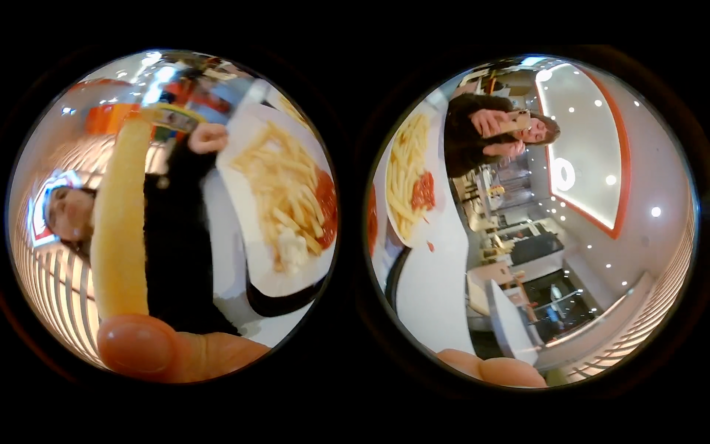
by Sabrina Labis
Summer Semester 2026
Universität der Künste Berlin
“There is a power in looking.”
— bell hooks
What does it mean to look — and what does it mean to be looked at?
Taking bell hooks’ assertion that looking is never neutral as a starting point, the seminar explored the gaze as a site of power, negotiation, and resistance. Looking was understood not simply as a technical function of the camera, but as a social, political, and aesthetic relation: a way of positioning bodies, constructing images, producing visibility, and shaping who is allowed to look, who is being looked at, and from where.
Starting with John Berger’s publication and television series Ways of Seeing, the seminar explored how ways of looking are shaped by cultural, social, and technological structures. Building on feminist film theory, we engaged with Laura Mulvey’s concept of the male gaze and bell hooks’ notion of the oppositional gaze. These perspectives were brought into dialogue with postbinary and postcolonial approaches, opening up a discussion around the encoded gaze and the ways in which contemporary technologies participate in the production, classification, and circulation of images. To further explore these questions, we invited artist Ornella Fieres for an Artist Talk, who expanded the discussion into the realm of algorithmic image production and contemporary visual cultures.
Alongside theoretical discussions and film screenings, the seminar became a space for looking at one another’s work — and for questioning how we look.
A central part of the collective process was the development of new forms of feedback. The students experimented with ways of responding to images that moved beyond familiar structures of critique and evaluation. Rather than asking simply whether a film “worked,” the feedback sessions became exercises in attentive and situated looking: What does an image make visible? Where does it position the viewer? What remains outside the frame? What kinds of bodies, experiences, or perspectives does it allow to emerge — and which does it leave unseen?
Particular attention was given to films that the students themselves were not satisfied with. These works were screened collectively and became occasions to look again, together. Instead of treating dissatisfaction as a failure or as the end of a film’s development, the group approached these moments as openings: opportunities to return to an image, to shift perspective, and to discover possibilities that might not have been visible to the filmmaker alone.
In this process, looking became a shared practice. A film could be returned to its maker through the eyes of others, transformed through conversation, and opened up to new readings. The students developed a collective vocabulary for speaking about images while remaining attentive to the power relations embedded within the act of looking itself.
The seminar ultimately became less about finding the “right” way of seeing than about making space for other ways of seeing. Through experimentation, exchange, and critical attention, the students explored how moving images can interrupt familiar visual conventions and create room for other perspectives.